
Cabinets
Used Kitchen Cabinets Orlando: Where to Find and How to Fit
Used kitchen cabinets in Orlando: where secondhand cabinets come from, how to inspect and measure them, pros and cons, and when refacing makes more sense.
By the Prime Construction team Updated October 13, 2026 8 min read
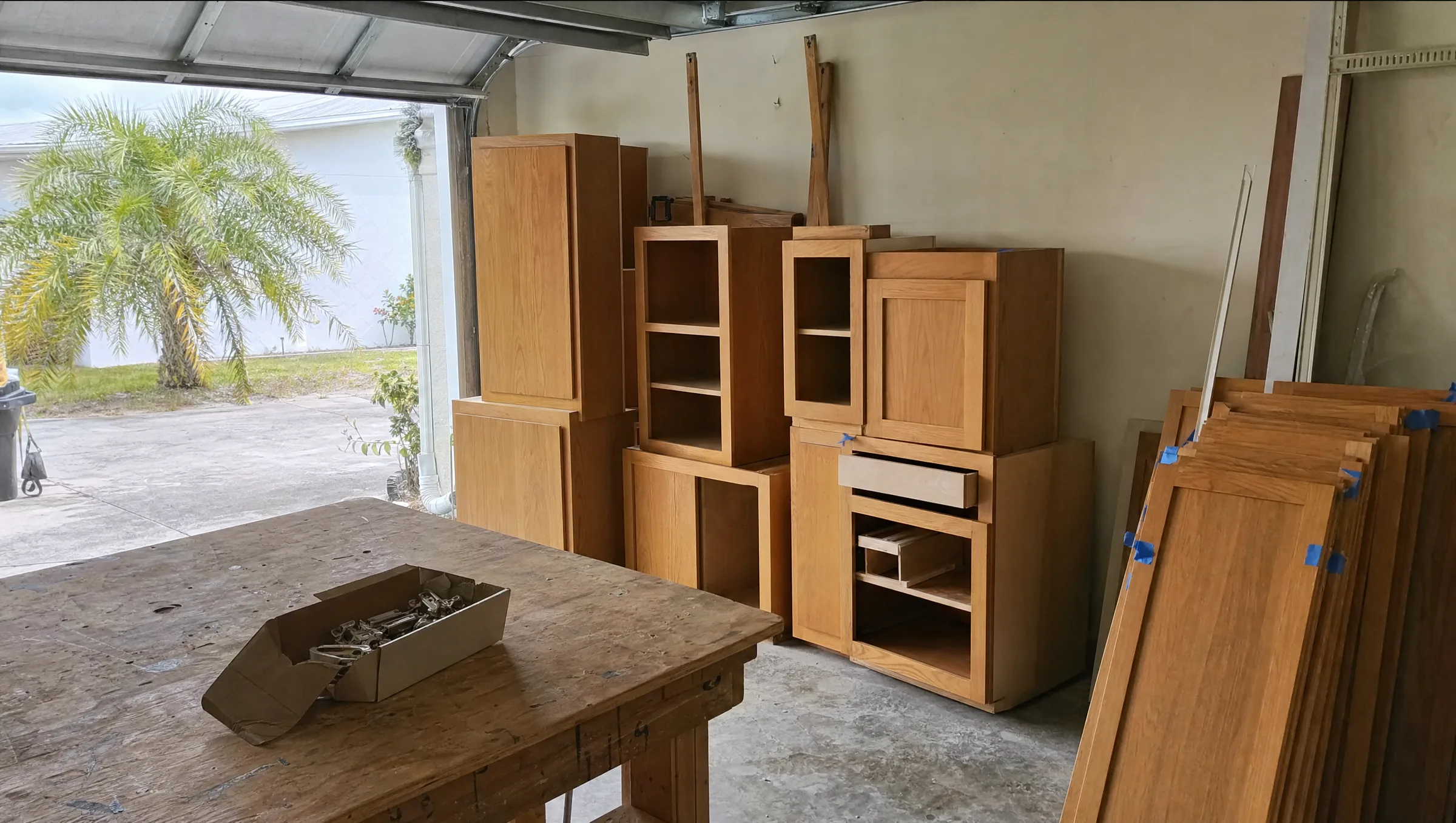
Used kitchen cabinets in Orlando can save real money, but only when the cabinets are in good structural shape and close to the sizes your kitchen needs. Most secondhand cabinets come from nonprofit reuse stores, online local marketplaces, remodel salvage, and model-home or showroom displays. The buying skill that matters most is not finding cabinets, it is inspecting and measuring them so you do not pay to haul home a set that will not fit. Below is how each source works, what to check, how to measure, and when refacing or new stock cabinets are the smarter call.
Where used kitchen cabinets come from
Supply in the Orlando area is steady because so many homes are remodeled every year. The cabinets themselves come from a handful of channels, and each has its own trade-offs.
Nonprofit reuse stores
Several nonprofits in Central Florida run reuse stores that sell donated building materials, including full kitchen sets, single wall cabinets and vanities. Prices are usually low and the money supports the nonprofit’s work. The catch is that inventory turns over fast and you rarely get a complete matching kitchen. These stores are a good source for a laundry room, garage, workshop or a few extra wall cabinets.
Online local marketplaces
Homeowners and flippers list cabinets online when they remodel. This is where you are most likely to find a complete kitchen set, sometimes with the countertop, sometimes with appliances. You usually have to remove the cabinets yourself or pick them up from a garage, so bring help, a truck, and blankets to protect the doors.
Ask the seller for:
- A photo of the kitchen before removal, so you can see the full layout.
- Overall run lengths and a count of base, wall and tall cabinets.
- Whether the cabinets were ever near a leak, and why they are being removed.
Remodel and demolition salvage
Some cabinets come straight from remodels and teardowns. When the removal is done carefully, these can be good sets from homes that simply changed style. When it is done fast, the face frames get cracked, the backs get torn, and the boxes rack out of square. Look closely at how the cabinets were pulled off the wall.
Model-home and showroom displays
Builders and cabinet dealers periodically sell off display kitchens when they change styles or close a model. These are often the best quality used cabinets you will find: lightly used, usually higher grade, and sometimes sold with the countertop. They also tend to be sized for a specific room, so measure carefully before you commit.
Scratch and dent cabinets
Not strictly used, but often shopped alongside them. Scratch and dent cabinets are new units with shipping damage, returns or discontinued finishes. The boxes are new and sized in standard increments, which makes them easier to fit than a used set pulled from someone else’s kitchen.
How to inspect used cabinets before you buy
A good used cabinet is one with a sound box. Doors and finishes can be fixed or replaced; a swollen or moldy box cannot. Bring a flashlight and a tape measure, and check each piece.
Water damage. Look at the sink base first, then the bottom shelf and floor of every base cabinet. Swelling, bubbling, dark stains, soft spots and delaminating veneer all mean the box has been wet. Particleboard that has swollen will not go back to its original shape.
Smell. In Florida humidity, a musty or mildew smell is a real warning sign. If a cabinet smells after you clean it, it will keep smelling in your kitchen.
Termites and pests. Drywood termites are common in Central Florida. Look for small piles of pellet-like droppings, pinholes or hollow-sounding wood, especially in solid wood face frames. Also check for droppings from rodents or roaches in the back corners.
Box material. Plywood boxes hold screws and tolerate moving far better than particleboard. Solid wood face frames and doors can be refinished; thermofoil and laminate faces are hard to repaint and peeling foil is not repairable.
Square and complete. Measure both diagonals of the face. If they differ by more than about 1/8 in., the box has been racked. Count doors, drawer fronts, shelves, fillers, end panels, toe kicks and crown pieces. Missing matching parts is the most common reason a “complete” used kitchen ends up costing more than expected.
Hardware. Open and close every door and drawer. Concealed hinges and drawer slides can be replaced, but the cabinet has to be drilled for the right hinge type. Note what you will need to buy.
Lead paint. Painted cabinets from homes built before 1978 may have lead paint under newer coats. Test before you sand. The EPA’s lead guidance explains safe practices for renovation and repainting.
Measuring and planning for a perfect fit
The difference between a bargain and a headache is usually the measuring. Do it before you shop, not after.
Measure your kitchen first
- Measure each wall from corner to corner at countertop height and again near the floor. Old walls are rarely perfectly straight or square.
- Mark windows, doors, the sink centerline, the range and refrigerator openings, outlets, the dishwasher opening and any soffits.
- Measure the ceiling height. Standard wall cabinets are 30, 36 or 42 in. tall, and the room above them affects which ones fit.
- Sketch the layout on graph paper with every opening labeled. Our guide to kitchen design drawing walks through it.
Know the standard sizes
Most cabinets follow common dimensions, which is what makes mixing and matching possible:
| Cabinet | Typical height | Typical depth | Common widths |
|---|---|---|---|
| Base | 34.5 in. (about 36 in. with countertop) | 24 in. | 9 to 48 in., in 3 in. steps |
| Sink base | 34.5 in. | 24 in. | 30, 33 or 36 in. |
| Wall | 30, 36 or 42 in. | 12 in. | 9 to 36 in., in 3 in. steps |
| Tall pantry | 84, 90 or 96 in. | 12 to 24 in. | 18 to 36 in. |
Plan the fit
- Appliance openings. A dishwasher needs a 24 in. opening, a standard range 30 in., and the refrigerator opening should match the fridge width plus a little air space. These openings cannot be squeezed.
- Fillers. Small gaps of 1 to 3 in. are closed with filler strips. If you need fillers of 6 in. or more, the set probably does not fit your room.
- Corners. Used sets are often from a different corner arrangement. A blind corner cabinet that turned left in the old kitchen may need to turn right in yours.
- Countertops. A used countertop was cut for someone else’s layout, with their sink and cooktop cutouts. Plan on a new top in most cases.
Real pros and cons of used kitchen cabinets
Pros
- Low upfront cost for the cabinets themselves, especially from reuse stores and online sellers.
- Older solid wood cabinets can be better built than some new entry-level boxes.
- Keeps usable material out of the landfill.
- Fast, since there is no factory lead time.
Cons
- You rarely get a set that matches your room’s dimensions.
- Hidden water or pest damage is common.
- Missing parts (fillers, panels, matching doors) are hard to source.
- Installation labor is often higher, because the installer has to scribe, fill and adapt pieces that were not made for the room.
- Usually no manufacturer support, and finish touch-up paint will not match.
The labor point is the one homeowners miss. A professional installer spends more time making a used set fit than installing a new set ordered for the space. When you get bids, ask for the installation price with the specific cabinets you plan to use.
Refinishing and customizing your finds
Once the boxes pass inspection, refinishing is where used cabinets pay off.
- Clean first. Kitchen grease is the main reason paint fails. Degrease thoroughly before any sanding.
- Paint or stain. Solid wood and veneer can be scuff-sanded, primed with a bonding primer and painted with a cabinet-grade enamel. Spraying gives a smoother finish than brushing.
- New hardware. Updated pulls and soft-close hinges make an older set feel current. Check that new pulls match the existing hole spacing, or plan to fill and redrill. See our kitchen cabinet hardware guide for sizes and finishes.
- New doors. If the boxes are sound but the doors are dated, new doors and drawer fronts on the old boxes is a hybrid approach that often looks like a new kitchen.
When refacing or new stock cabinets make more sense
Used cabinets are a great fit for a garage, laundry room, workshop, rental unit or a small kitchen where a found set happens to match. For a main kitchen, run the numbers both ways.
Consider refacing if your existing cabinet boxes are solid and the layout works. Cabinet refacing replaces the doors and drawer fronts, covers the boxes with new veneer and adds new hardware. For an average kitchen in the Orlando area, refacing typically runs $7,000 to $15,000 in 2026, and it is usually 40 to 50 percent less than comparable new cabinets. You keep your existing countertops in many cases and skip the guesswork of fitting someone else’s kitchen. Our cabinet refacing cost guide has the details.
Consider new stock cabinets if your boxes are damaged or you want to change the layout. Stock cabinets come in the standard sizes above, are ordered for your exact room, and arrive complete with matching fillers and panels. In a full remodel, cabinets are usually 30 to 40 percent of the total budget, so this is where shopping carefully matters. Our kitchen cabinets service covers stock, semi-custom and custom options.
Stick with used when the set is solid, nearly the right size, and you are comfortable doing some of the removal, cleaning and refinishing yourself.
Donating or selling your old cabinets
If you are on the other side of this, your old cabinets may be someone else’s find. Many reuse stores accept cabinets in good condition, and some will pick up. Ask your contractor to remove them carefully (unscrewed, not pried off) and to keep doors, shelves and hardware together. Cabinets with water damage, mold or broken boxes are usually not accepted.
Planning a cabinet project in Orlando?
Whether you are weighing a used set, refacing or new cabinets, the right answer depends on the condition of your current boxes and the dimensions of your room. Prime Construction visits your home, measures, and builds a 3D design rendering so you can compare options before anything is ordered. If you are in Orange, Seminole, Osceola or Lake County, call (407) 404-3944 or request an estimate.