
Countertops
Quartz Bathroom Countertops: Costs, Colors and Care
Quartz bathroom countertops guide: why quartz suits vanities, colors and finishes, sinks, faucet holes, edges, thickness, care and Orlando-area costs.
By the Prime Construction team Updated October 13, 2026 6 min read
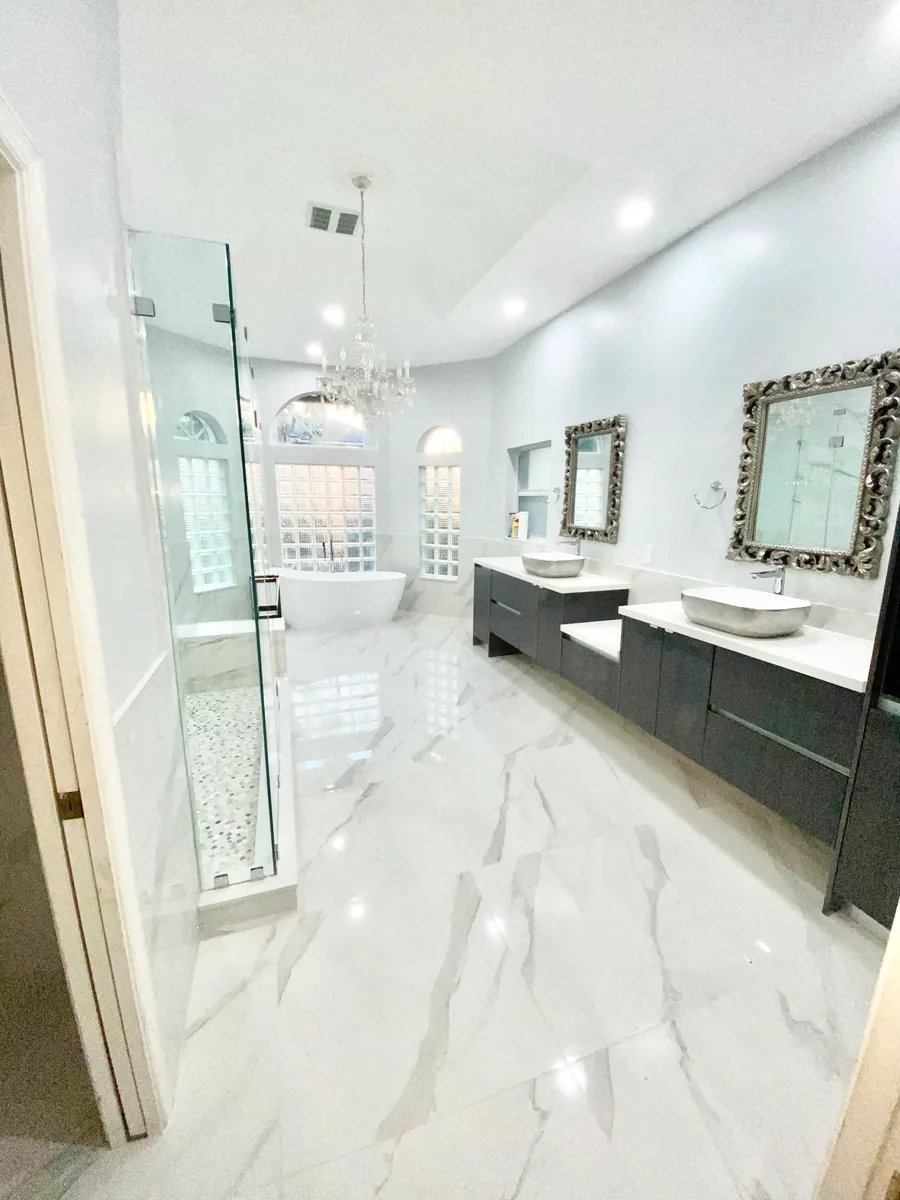
Quartz bathroom countertops are engineered stone vanity tops made mostly of crushed natural quartz bound with resin. They are a strong fit for bathrooms because they are non-porous, so water and toiletries do not soak in, they never need sealing, and they resist stains and scratches. In the Orlando area, quartz typically runs about $60 to $120 per square foot installed in 2026. Below we cover why quartz works in a bathroom, how to choose the color, finish, sink and edge, how it compares with other vanity materials, and how to care for it.
Why quartz works in a bathroom
It does not absorb water. A vanity top sees splashing every day, plus toothpaste, makeup, hair dye and cleaning products. Quartz is non-porous, so those stay on the surface and wipe off. In humid Central Florida bathrooms, that also means no moisture soaking into the top.
No sealing. Granite and marble benefit from periodic sealing, especially around the sink. Quartz needs none.
It is hard and stain resistant. Daily use, dropped bottles and sliding toiletries are not a problem for most quartz.
It is consistent. The slab you see in a sample looks like the top you get, which makes it easy to match a vanity top to a shower curb, bench or tub deck in the same material.
The cautions:
- Heat. The resin can scorch from direct heat. Set curling irons and flat irons on a heat-resistant mat, not on the bare top.
- Harsh chemicals. Some drain cleaners, bleach, paint strippers and oven cleaners can dull or discolor the resin. Wipe spills promptly.
For how quartz is made and how it differs from the natural mineral and quartzite, see our guide to quartz stone.
Colors and patterns
- White and off-white with light veining: the most popular choice; makes a bathroom look bright and clean.
- Marble-look with bold veining: a classic look without marble’s sealing and etching.
- Gray and greige: forgiving with soap residue and water spots.
- Warm tones such as cream, beige and soft taupe: pair well with wood vanities.
- Dark and concrete-look: dramatic, but dark polished tops show water spots and dust more than light ones.
Pick the top with your tile and vanity color in hand. Light quartz on a dark vanity, or a darker top on a white vanity, both work; the top should not compete with a busy shower tile.
Finishes
- Polished: glossy, easy to wipe, reflects light. The most common bathroom finish.
- Honed or matte: a soft, modern look; shows fingerprints and oily marks a bit more.
- Textured: less common on vanities because it holds residue.
Sinks, faucet holes and backsplash
Plan these before the top is fabricated. They cannot be changed easily after.
Sink options
| Sink type | How it works | Notes |
|---|---|---|
| Undermount | Mounted under the top; polished cutout edge | Cleanest look, easy to wipe into; most common with quartz |
| Vessel | Sits on top of the counter | Needs a taller faucet or wall-mount faucet; lower vanity height may be more comfortable |
| Drop-in | Rim sits on top of the counter | Budget friendly; rim collects grime |
Faucet drilling
- Single hole: one-handle faucets.
- 4 inch centerset: three holes spread over 4 inches.
- 8 inch widespread: separate handles, three holes about 8 inches apart.
- Wall-mount faucet: no holes in the top; the plumbing moves into the wall, which is a plumbing change.
Have the faucet on hand or the spec sheet ready when the top is templated.
Backsplash and sidesplash
A 4 inch backsplash in matching quartz is standard on vanity tops, plus a sidesplash where the vanity meets a side wall. Many homeowners skip it and tile the wall instead, or run the quartz full height behind the vanity.
Edges and thickness
- Eased edge: square with slightly softened corners; modern and common.
- Bevel: an angled top edge.
- Half bullnose or full bullnose: rounded, friendly to hips in a tight bathroom.
- Ogee: a decorative S-curve for traditional styles.
- Mitered: two pieces joined to look like a thick slab; used to make 2 cm look heavier.
Most vanity tops are 2 cm thick; 3 cm is used for a heavier look or to match the kitchen.
Quartz vs other vanity top materials
| Material | Maintenance | Heat | Look | Installed cost (Orlando, 2026) |
|---|---|---|---|---|
| Quartz | No sealing | Use a mat for hot tools | Consistent, many colors | About $60 to $120 per sq ft |
| Granite | Seal periodically | Handles heat well | Natural pattern | About $50 to $100 per sq ft |
| Marble | Seal; etches from acids | Handles heat | Classic veining | About $75 to $200+ per sq ft |
| Quartzite | Usually seal | Handles heat well | Natural, marble-like | About $80 to $200+ per sq ft |
| Cultured marble | Low; can scratch and dull | Can crack from heat | Molded top and sink in one | Usually below stone; varies |
| Laminate | Low; seams can swell with water | Poor | Many patterns | About $25 to $50 per sq ft |
For a direct comparison of the two most common choices, see our quartz vs granite countertops guide.
Custom tops vs prefabricated quartz vanity tops
Prefabricated tops come in standard widths (such as 25, 31, 37, 49, 61 and 73 inches for 24 to 72 inch vanities) with a pre-cut sink and faucet holes. They are faster and often cheaper, but limit color, sink and faucet choices.
Custom fabricated tops are templated from your vanity and walls. They fit walls that are out of square, allow any sink and faucet layout, and can match your kitchen or shower material. Remnants (leftover pieces from larger slabs) can make custom quartz affordable for a single vanity.
If you are swapping only the top, our guide to quartz vanity tops covers measuring and installation.
Cleaning and caring for quartz in the bathroom
- Daily: wipe with warm water and mild dish soap, then dry with a soft cloth to prevent water spots.
- Dried toothpaste, hairspray, makeup: a cleaner labeled safe for quartz, or a little isopropyl alcohol on a cloth.
- Stuck-on residue: scrape gently with a plastic putty knife.
- Avoid: bleach, oven cleaner, abrasive powders and scouring pads.
- Hot tools: always on a heat-resistant mat.
- Caulk: keep the joint between the top and the wall, and around an undermount sink, in good shape. That joint keeps water out of the vanity cabinet.
What quartz bathroom countertops cost
Typical Orlando-area planning ranges for 2026: quartz is about $60 to $120 per square foot installed. Installing a stone top on an existing vanity typically runs $250 to $700 in labor, with the top priced separately by size and options. What moves the price:
- Color and pattern (plain colors cost less than bold veining).
- Sink cutouts, faucet holes and edge profile.
- Backsplash and sidesplash pieces.
- Plumbing changes, such as a new faucet location or a wall-mount faucet.
- Replacing the vanity cabinet at the same time.
Small tops can carry minimum fabrication charges, so ask for a complete price. A written estimate after measuring is the only real number.
Planning a vanity upgrade in Orlando?
A quartz top is often paired with a new vanity or a full bathroom update. Our bathroom vanity and bathroom remodeling services cover the cabinet, top, sink and plumbing together, and plumbing work is handled under our plumbing license. If you are in Orange, Seminole, Osceola or Lake County, Prime Construction can measure and quote it. Call (407) 404-3944 or request an estimate.