Cabinets
Shaker Cabinets: Styles, Colors, Cost and Buying Guide
Shaker cabinets explained: what makes a door Shaker, construction grades, popular colors and hardware, cost factors, and refacing vs new in Orlando.
By the Prime Construction team Updated October 13, 2026 5 min read
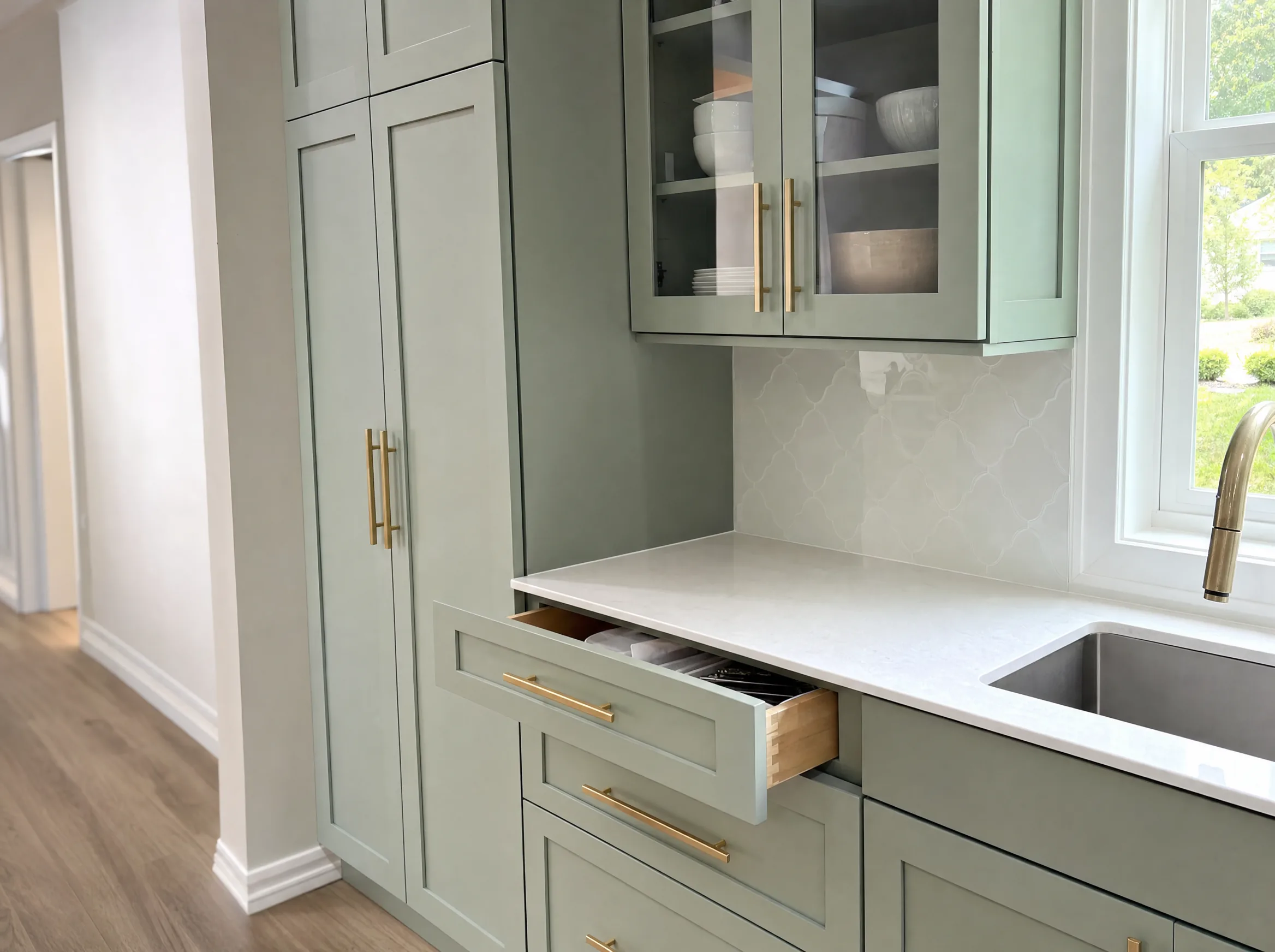
As of October 2026, Shaker cabinets are still the most widely chosen cabinet door style for kitchen remodels. A Shaker cabinet has a five-piece door: a flat, recessed center panel inside a square frame with no decorative profile. Shaker is a style, not a quality level, so you can buy it in stock, semi-custom or custom construction. What you pay depends on the box material, the door material and finish, and whether you replace the cabinets or reface the boxes you already have.
Shaker cabinets at a glance
| Question | Short answer |
|---|---|
| What defines the style | Five-piece door, square inside edge, flat recessed panel |
| Typical rail and stile width | About 2 to 3 inches (narrower reads more modern) |
| Common door materials | Painted MDF center panel with hardwood frame, solid hardwood, thermofoil, wood veneer |
| Works with | Modern, transitional, farmhouse, coastal and traditional kitchens |
| Cost driver | Construction grade and finish, not the door style itself |
| Budget shortcut | Refacing existing boxes with new Shaker doors and drawer fronts |
| Typical refacing range (Orlando, 2026) | $7,000 to $15,000 for an average kitchen |
What makes a cabinet “Shaker”
The look comes from the woodworking of the Shaker communities, who built plain, functional furniture with careful joinery. A modern Shaker door keeps those traits:
- Five pieces: two vertical stiles, two horizontal rails and one center panel.
- Square inside edge: the frame meets the panel with a clean step, not a curved or beveled profile.
- Flat recessed panel: no raised center, no arch.
- No applied ornament: no carving, corbels or rope molding.
Variations you will see:
- Slim Shaker: rails and stiles around 1 to 1.5 inches. Reads very modern, close to a slab door.
- Shaker with a small bead or bevel on the inside edge: a softer, more traditional take.
- Shaker drawer fronts vs slab drawer fronts: many kitchens use Shaker on doors and large drawers but a slab front on short top drawers, where a frame would look cramped.
Construction: what to check before you buy
Two Shaker doors can look identical in a showroom and perform very differently in a humid Orlando kitchen. Check these parts:
Cabinet boxes
- Plywood boxes hold screws well and resist moisture better at the sink base.
- Particleboard boxes cost less and are fine in dry locations if the edges are sealed, but they swell when they get wet.
- Look at the sink base in particular. A leak under the sink is the most common way cabinets fail.
Doors and finish
- Painted Shaker doors usually have a hardwood or MDF frame with an MDF center panel. MDF is stable and paints smoothly. Solid wood panels can expand and contract with humidity, which can show as a thin unpainted line at the panel edge on painted doors.
- Stained Shaker in oak, maple or walnut shows the wood grain and hides small dings well.
- Thermofoil and laminate faces are budget friendly and easy to clean, but they do not like heat; keep them away from an oven without a heat shield.
Hardware and drawers
- Soft-close hinges and full-extension, soft-close drawer slides make a bigger daily difference than the door style.
- Dovetail or doweled drawer boxes outlast stapled ones.
Popular Shaker cabinet colors and pairings
- White or warm white Shaker with quartz counters and a subway or zellige-style backsplash. Bright and easy to sell.
- Two-tone: navy, deep green or charcoal lowers with white uppers, or a contrasting island.
- Greige and soft gray: neutral, hides fingerprints better than bright white.
- Natural wood Shaker: white oak or rift-cut oak is a common modern choice; it pairs well with light stone.
- Black Shaker on an island with brass hardware for contrast.
Hardware sets the tone. Bar pulls and edge pulls lean modern, cup pulls lean farmhouse, and knobs on doors with pulls on drawers is a classic mix. Long pulls on tall pantry doors are easier to use. For countertop pairings, our quartz vs granite countertops comparison covers the two most common choices.
What Shaker cabinets cost
Shaker does not have its own price. The same door is sold in every tier, and the line items that move the price are box material, finish, custom sizing and accessories. Useful reference points for Orlando in 2026:
- New cabinets in a full remodel: cabinets are usually the largest single line, roughly 30 to 40 percent of a full kitchen budget. In a mid-range remodel of $35,000 to $75,000, that is roughly $10,500 to $30,000 for cabinets by simple arithmetic.
- Refacing with Shaker doors: new doors, drawer fronts, veneer on the existing boxes and hardware typically runs $7,000 to $15,000 for an average kitchen, usually 40 to 50 percent less than comparable new cabinets.
- Cosmetic refresh (same layout, reface or refinish cabinets, new counters, backsplash, sink, faucet and lighting): $15,000 to $35,000.
What pushes cabinet cost up:
- Custom sizes and filler-free layouts.
- Painted finishes in custom colors, or glazes.
- Inset Shaker (the door sits inside the face frame) instead of overlay. Inset requires tighter tolerances and more labor.
- Accessories: pull-out pantries, trash pull-outs, drawer organizers, corner systems.
- Moving plumbing or walls, which changes the whole project scope.
Refacing vs new Shaker cabinets
Refacing is the most common way Orlando homeowners get a Shaker look without replacing everything.
Refacing makes sense when:
- The cabinet boxes are solid, dry and square.
- You like the layout and the storage.
- You want a shorter project with the kitchen usable most of the time.
New cabinets make sense when:
- Boxes are water damaged, sagging or particleboard that has swelled.
- You want to change the layout, add an island or move the sink or range.
- You want more drawers, taller uppers or better storage than the current boxes allow.
Our cabinet refacing cost guide goes deeper on the numbers and on what refacing can and cannot fix. If you are weighing secondhand cabinets instead, see our buyer’s guide to used kitchen cabinets in Orlando.
Overlay types and how they change the look
- Full overlay: doors cover almost all of the face frame. The most common modern Shaker look.
- Partial overlay: more frame shows between doors. Less expensive, more dated.
- Inset: doors sit flush inside the frame. A furniture-quality look with a higher price.
Planning Shaker cabinets in Orlando?
The right Shaker cabinet depends on what your current boxes can support, how you use the kitchen and the layout you want. Prime Construction measures your kitchen, shows you the design in a 3D rendering, and helps you compare new cabinets with refacing. Learn more about our kitchen cabinet services or cabinet refacing, call (407) 404-3944, or request an estimate.